
Marionette Lines or Sagging Skin? What Causes Shadows Around the Mouth

Special Offers

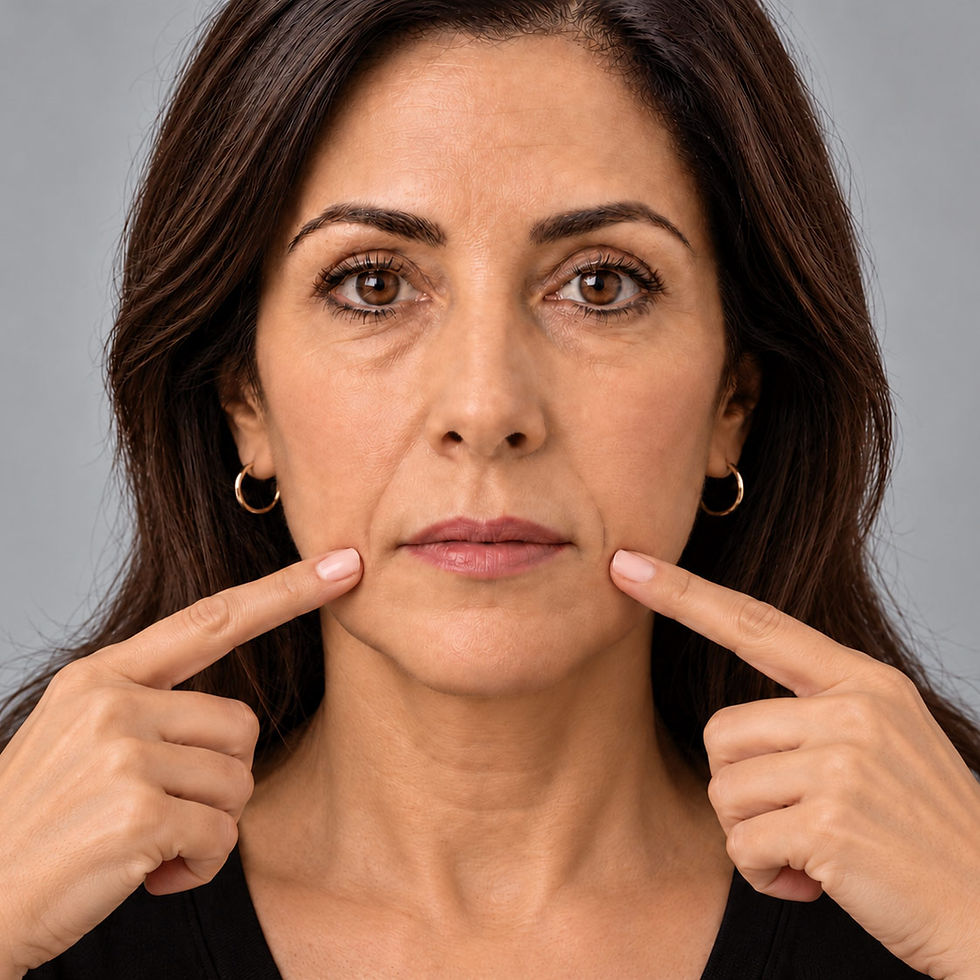
Have you ever noticed a new shadow beside your mouth and assumed your skin was beginning to sag?
Perhaps you first noticed it in a photograph. The corners of your mouth seem slightly lower, a faint hollow has appeared between your chin and jawline, or your lower face looks less defined than it once did.
You might describe these changes as marionette lines, sagging skin or simply the first signs of ageing.
But what if the skin itself is not the main problem?
One of the most interesting things about facial ageing is that what we see on the surface does not always tell us what is happening underneath.
A shadow beside the mouth can be caused by several different changes. The skin may have lost some elasticity. The fat beneath it may have changed in volume or position. The supporting structures of the face may have altered. Sometimes, the natural shape of the face simply becomes more noticeable as we age.
These changes can produce remarkably similar appearances, even though their underlying causes are different. This matters because treating a shadow as though it were simply loose skin may not produce the improvement someone expects.
Before asking how to remove marionette lines, we need to understand what creates them.
What are marionette lines, and why do they appear?
Marionette lines are folds or creases that extend downwards from the corners of the mouth towards the chin or jawline. Their name comes from the resemblance to the movable mouth of a traditional marionette puppet.
They are sometimes called labiomandibular folds.
However, not every shadow around the mouth is a true marionette line.
Some people develop a visible crease beneath the corner of the mouth. Others notice a hollow beside the chin, a slight bulge along the jawline or a darker area that appears more pronounced under certain lighting.
Although these features are often grouped together as lower-face sagging, they can arise from different anatomical changes.
For example, a depression beside an area of retained fullness can create a shadow even when the overlying skin remains relatively firm.
Similarly, a change in the shape of the jawline may make the mouth appear more downturned without the skin having significantly loosened.
The distinction is subtle, but clinically important.
A line, a hollow and a fold are not necessarily the same problem.
The anatomy of lower-face ageing: what happens beneath the skin?
Facial ageing is often described as a gradual loss of collagen followed by sagging.
That explanation is incomplete.
Our faces are composed of several interconnected layers: skin, subcutaneous fat, muscles, connective tissues and bone. Each contributes to facial shape, and each changes differently over time.
Understanding these layers helps explain why shadows around the mouth can develop even when the skin itself is not particularly loose.
1. Skin laxity: when the skin loses firmness and elasticity
Collagen gives the skin much of its strength and structural integrity, while elastin helps it return towards its original position after stretching.
Over time, changes in collagen, elastin and the surrounding extracellular matrix can reduce skin firmness.
Sun exposure, smoking, genetics and hormonal changes can accelerate some of these processes.
In the lower face, reduced elasticity may contribute to fine creasing, a softer jawline and folds that become more noticeable during movement.
This is genuine skin laxity.
However, improving collagen production does not automatically restore the deeper structures supporting the face. That distinction becomes particularly important when considering skin-tightening treatments.
2. Facial fat compartments: when fullness changes position or distribution
The face does not contain one continuous, uniform layer of fat.
Instead, facial fat is organised into distinct compartments that contribute to the contours of the cheeks, mouth, chin and jawline.
As we age, these compartments can change in volume and their relationship to surrounding tissues.
Some regions lose fullness. Others may become relatively more prominent.
Consider the area immediately beside the corner of the mouth. If one part of the lower face becomes slightly hollow while the neighbouring area retains more fullness, the contrast between them becomes more visible.
Light catches the fuller area while the depression remains in shadow.
The result may resemble a deepening marionette line. Yet the primary change may be one of facial contour rather than skin laxity. This is one reason why simply tightening the skin may not eliminate the shadow.
3. Bone and structural support: the foundation we rarely consider
We often imagine the facial skeleton as a permanent framework.
In reality, bone undergoes remodelling throughout life, and age-related changes in the facial skeleton can influence the appearance of the overlying soft tissues.
The lower jaw, or mandible, is particularly relevant to the area around the mouth.
Changes in the jaw's shape and supporting contours can contribute to a depression in front of the jowl, known as the prejowl sulcus.
This can interrupt the smooth transition between the chin and jawline.
The resulting hollow may create a shadow that is mistaken for a marionette line.
A treatment that improves the skin's surface cannot recreate the original shape of the underlying bone.
It may improve the quality of the skin covering that area, but the structural contour can remain.
4. Muscles and connective tissue: why the corners of the mouth change
Facial muscles influence expression and the resting position of the mouth. One muscle, the depressor anguli oris, helps pull the corners of the mouth downwards.
The appearance of the mouth corners also depends on neighbouring muscles, tissue support and individual anatomy.
Some people naturally have downturned mouth corners. Others notice that this feature becomes more pronounced over time. Meanwhile, changes in connective tissue and retaining structures can influence how the soft tissues of the lower face are supported.
The visible result may be a combination of a downward-facing mouth corner, a shallow fold and a shadow beneath it. This is why two people with similar-looking marionette lines may require entirely different treatment approaches.
Marionette lines versus sagging skin: how can you tell the difference?
There is no single visual test that reliably identifies the cause of a shadow beside the mouth.
However, the characteristics of the change can provide useful clues.
What you notice | Possible explanation |
Fine creases and loose-looking skin | Reduced skin elasticity or mild skin laxity |
A hollow beside the mouth | Localised volume loss or natural facial contour |
A bulge next to a hollow | Changes in fat distribution or early jowling |
Downturned mouth corners | Muscle activity, tissue support or natural anatomy |
Reduced jawline definition | A combination of laxity, fat distribution and structural ageing |
A shadow visible mainly in photographs | Directional lighting emphasising existing facial contours |
These are possibilities, not diagnoses.
Many people experience several of these changes simultaneously.
For instance, someone may have mild skin laxity alongside a deeper structural hollow. Treating only one component may improve the appearance without completely removing the shadow.
An experienced practitioner should therefore assess the face in motion as well as at rest.
The aim is not simply to identify a line, but to understand why that line has become visible.
Why treating marionette lines as sagging skin can produce disappointing results
Imagine two women in their early fifties.
Both are concerned about shadows extending downwards from the corners of their mouths.
The first has relatively good facial volume but noticeable changes in skin elasticity. Her skin appears slightly crepey, and the lower face has lost some firmness. The second has good skin quality but a more pronounced hollow beside the chin, caused partly by changes in volume and structural support.
Both might describe their concern as sagging skin.
Yet the treatment priorities would be different.
For the first woman, collagen stimulation may be a reasonable consideration.
For the second, improving skin quality alone is unlikely to correct the underlying hollow.
This is where aesthetic treatment can become unnecessarily complicated.
When the visible concern is mistaken for the underlying cause, clients may undergo repeated treatments without achieving the change they hoped for.
The most appropriate treatment is not necessarily the one that promises the greatest amount of tightening. It is the one that addresses the anatomy responsible for the concern.
Which treatments can improve marionette lines and lower-face sagging?
Treatment selection depends on whether the primary concern is skin quality, laxity, volume loss, structural support or a combination.
These approaches work in different ways and should not be regarded as interchangeable.
Collagen-stimulating treatments for mild skin laxity
Where reduced firmness and mild laxity are the main concerns, collagen-stimulating treatments may be appropriate. These include conventional microneedling, radiofrequency microneedling and selected fractional laser treatments.
Their purpose is to stimulate tissue repair and collagen remodelling within the skin.
For example, radiofrequency microneedling combines controlled needle penetration with radiofrequency energy to create thermal effects at selected tissue depths.
Fractional CO₂ laser resurfacing works differently, creating microscopic zones of controlled injury that encourage skin renewal and remodelling.
At NovaLx Skin Clinic, Cutera Secret PRO provides access to RF microneedling and fractional CO₂ resurfacing technologies.
These treatments may improve texture, fine lines and aspects of skin firmness in appropriately selected clients.
However, they cannot be expected to restore significant facial volume or reverse changes in the underlying jawbone.
Radiofrequency microneedling also carries risks, including burns, scarring and unwanted fat loss. Appropriate treatment depth, energy selection, practitioner training and patient selection are particularly important in a face where volume loss is already contributing to the concern.
Skin-quality treatments when texture and hydration are the priority
Sometimes the concern is not a pronounced fold but the way the skin looks around it.
Dryness, uneven texture and fine lines can make existing facial contours appear more noticeable.
A skin-quality approach may involve a personalised homecare routine, gentle resurfacing, microneedling or carefully selected injectable skin boosters.
Polynucleotide treatments may also be considered for certain skin-quality concerns, although the evidence remains developing and results vary between products and indications.
The aim is to improve the condition of the skin rather than change the shape of the lower face.
Better-hydrated, smoother skin may reflect light more evenly.
However, this should not be confused with correction of a deeper structural hollow.
Biostimulators when gradual collagen support is appropriate
Injectable biostimulators are designed to stimulate a tissue response that may increase collagen formation over time.
Examples include products based on poly-L-lactic acid or calcium hydroxylapatite.
Depending on the product and technique, they may contribute to tissue support, volume restoration or improved skin characteristics.
Their effects are generally gradual, with collagen-related changes developing over subsequent months. They are not suitable for every client or every area of the face.
The evidence also varies by product and indication, and complications can include nodules, inflammatory reactions and vascular injury.
These treatments require an appropriately qualified medical practitioner and a careful assessment of facial anatomy.
Dermal fillers when volume loss is the main concern
Where a genuine structural hollow contributes to the appearance of marionette lines, hyaluronic acid dermal fillers may sometimes be considered.
Their role is different from that of collagen-stimulating treatments.
Rather than primarily improving the skin's surface, fillers can restore selected areas of volume or support.
However, this does not mean that filler should automatically be injected directly into every marionette line. The relationship between the chin, jawline, cheeks and lower face needs to be considered.
Adding too much filler can make the lower face appear heavy or unnaturally full.
There are also important medical risks, including vascular occlusion and, rarely, tissue necrosis or visual loss.
For clients seeking natural-looking results, careful assessment and conservative treatment planning are essential.
When no treatment is the most appropriate recommendation
Not every shadow requires correction.
Some people naturally have more pronounced contours beside the mouth.
Others notice shadows that are visible only under particular lighting conditions.
A small change may also be entirely consistent with normal facial ageing and not something the individual wishes to treat once they understand it.
There are circumstances in which non-surgical treatment is unlikely to achieve the desired improvement.
Significant tissue descent, for example, may require a surgical opinion if substantial lifting is the objective. A responsible consultation should make these limitations clear.
Choosing not to treat is as valid a decision as choosing to proceed.
How long does it take to see results?
One of the most common misunderstandings about non-surgical facial rejuvenation is that all treatments should produce an immediate visible improvement.
In reality, different treatments work on different timelines.
Treatment approach | Typical timeline | What to realistically expect |
Skincare and hydration | Days to several weeks | Improved comfort, hydration and surface appearance |
Microneedling | Several weeks to months | Gradual improvement in skin texture and fine lines |
RF microneedling | Approximately 2–6 months | Collagen remodelling and possible improvement in mild laxity |
Fractional CO₂ laser | Several weeks to months after healing | Improvement in texture, fine lines and selected skin-quality concerns |
Injectable skin boosters | Several weeks, depending on product | Changes in hydration and skin quality |
Biostimulators | Often 2–6 months | Gradual collagen-related changes and possible tissue support |
Hyaluronic acid fillers | Immediate initial effect, followed by settling | Selected volume and contour correction |
These timelines are indicative, not guaranteed. The number of sessions, degree of improvement and recovery period depend on the individual and the treatment.
Collagen stimulation is a gradual biological process.
It is also important to distinguish between a treatment that improves the quality of the skin and one that changes facial contours.
A client may experience visibly smoother, firmer skin while still retaining a shadow caused by deeper anatomical changes. That does not necessarily mean the treatment has failed. It may mean that the treatment has improved one component of a more complex concern.
Why marionette lines may become more noticeable during perimenopause and menopause
Many women begin to notice changes in their lower face during their forties and fifties.
For some, this coincides with perimenopause or menopause.
Oestrogen plays an important role in maintaining skin structure, hydration and collagen.
As oestrogen levels decline, the skin may become drier, thinner and less elastic.
Research has associated menopause with changes in dermal collagen and skin thickness, although the extent varies considerably between individuals.
These changes can make existing folds and shadows appear more pronounced.
However, menopause does not independently explain every change in the lower face.
Genetics, facial anatomy, sun exposure, weight fluctuations and deeper structural ageing continue to influence facial appearance.
This distinction is important because treating menopausal skin changes is not necessarily the same as treating facial volume loss. For some women, improving hydration, skin texture and collagen support may be a reasonable priority.
For others, the main concern may be a structural hollow that is unlikely to respond significantly to skin treatments alone.
The most appropriate approach depends on the individual rather than their age.
What should happen during a lower-face consultation?
A thoughtful consultation should begin with an assessment of the concern, not a recommendation for a particular device or injectable.
The practitioner should consider how the face looks at rest and during expression, the condition of the skin and the relationship between the mouth, chin, cheeks and jawline.
Several questions help guide the decision:
Is the concern primarily a line, a hollow or a fold? These may have different anatomical causes.
Is skin laxity genuinely present? Reduced firmness may contribute, but it should not be assumed.
Has facial volume or support changed? A structural hollow may need a different approach from crepey skin.
What degree of improvement is realistic? Non-surgical treatments have limitations, particularly where deeper tissue descent is involved.
Is treatment appropriate at all? The likely benefit should justify the cost, recovery and clinical risk.
Medical history, previous aesthetic treatments, skin type, pigmentation risk and individual expectations must also be considered.
Standardised photographs can help document changes, but photographs alone cannot establish what is happening within the deeper facial structures.
Where injectable structural correction is being considered, assessment by an appropriately qualified medical practitioner is essential.
And where a change is sudden, particularly new one-sided facial drooping, it should not be assumed to be cosmetic. Sudden facial weakness can be a sign of stroke and requires emergency medical assessment.
Why choose NovaLx Aesthetics?
At NovaLx Skin Clinic in Brierley Hill, our philosophy is to understand the skin and the structures influencing its appearance before deciding whether treatment is appropriate.
We place particular emphasis on collagen health, skin quality and natural-looking results.
For clients experiencing mild skin laxity or changes in texture, carefully selected regenerative and collagen-stimulating treatments may be appropriate.
Where the concern involves deeper volume loss or structural changes, a doctor-led assessment may be more suitable.
And where a treatment is unlikely to provide meaningful improvement, we believe that limitation should be explained clearly.
NovaLx Aesthetics welcomes clients from Dudley, Stourbridge, Halesowen, Wolverhampton and surrounding areas who are seeking a considered, personalised approach to skin ageing.
Our objective is not to remove every visible sign of age. It is to help clients understand their skin, make informed decisions and pursue improvements that remain in harmony with their natural facial features.
Final thoughts: not every shadow needs lifting
Return to the shadow beside your mouth.
What initially appeared to be sagging skin may be a combination of changing facial volume, reduced elasticity, altered tissue support or simply the natural contours of your face.
The shadow itself does not tell the whole story.
And this is why the question "How do I get rid of my marionette lines?" may not be the most useful place to begin.
A better question is:
What is actually creating this shadow, and which part of it, if any, can realistically be improved?
Sometimes the answer will involve collagen stimulation. Sometimes structural support or skin-quality treatments may be more appropriate. And sometimes, understanding the anatomy is enough to realise that no intervention is necessary.
Because the purpose of thoughtful aesthetic medicine should never be to treat every line we see. It should be to understand what we are looking at before deciding whether anything needs to change.
Frequently Asked Questions
1. What causes marionette lines around the mouth?
Marionette lines develop through a combination of factors, including reduced skin elasticity, changes in facial fat compartments, connective tissue support and the underlying facial skeleton. Muscle activity and natural facial anatomy can also influence their appearance. Some people develop pronounced marionette lines despite having relatively firm skin, which is why identifying the underlying cause is important before choosing treatment.
2. Are marionette lines caused by sagging skin or volume loss?
They can be caused by either, or by a combination of both. Skin laxity may contribute to folds around the mouth, while changes in facial volume can create hollows that produce a similar shadow. Changes in the jawline and deeper facial support can also contribute. A clinical assessment helps determine whether the concern is predominantly skin-related or structural.
3. Can you get rid of marionette lines without filler?
Some marionette-area concerns can be improved without filler, particularly where mild skin laxity or texture changes are contributing. Treatments such as microneedling, RF microneedling and selected resurfacing procedures may improve skin firmness. However, these treatments cannot reliably restore lost facial volume or eliminate deeper structural hollows. The most appropriate option depends on the cause and severity of the concern.
4. Does RF microneedling help marionette lines and lower-face sagging?
RF microneedling may improve mild skin laxity, fine lines and texture by stimulating collagen remodelling. It is less likely to correct pronounced marionette lines caused primarily by volume loss or deeper tissue descent. Treatment must be planned carefully because inappropriate energy delivery can cause complications, including unwanted fat loss, which may worsen some lower-face concerns.
5. Why are my marionette lines getting worse in my 40s or 50s?
Changes in collagen, skin elasticity, facial fat distribution and underlying structural support can make marionette lines more noticeable with age. During perimenopause and menopause, declining oestrogen may also contribute to reduced skin hydration and collagen. However, facial ageing varies considerably, and the appearance of marionette lines cannot be attributed to hormones alone.
6. What is the best treatment for deep marionette lines?
There is no single best treatment. Where deep marionette lines are caused by volume loss, carefully planned structural filler treatment may be considered. Where skin laxity is the main concern, collagen-stimulating procedures may offer some improvement. Significant tissue descent may not respond adequately to non-surgical treatment. The appropriate approach depends on anatomy, medical suitability and realistic expectations.
7. Can skincare prevent marionette lines?
Skincare can support skin health and help reduce some contributors to visible skin ageing. Daily broad-spectrum sunscreen, suitable moisturisers and evidence-based ingredients such as retinoids may improve skin quality over time. However, skincare cannot prevent all age-related changes in facial fat, bone and connective tissue, nor can it reliably reverse established structural hollows around the mouth.


Comments